
If you sell or shop across borders, understanding the de minimis threshold by country is one of the fastest ways to avoid surprise import costs. These thresholds decide when customs authorities waive duty and taxes on low-value shipments, and they vary dramatically from one market to another. In some countries you can import small orders almost tax-free; in others every parcel is assessed from the first cent.
In this guide, we explain how de minimis works, how duty and tax thresholds differ, and what that means for what you can import tax-free in key markets. We also show you how to use country-specific data and official guidance to plan your shipping strategy. For more on international shipping, visit our global shipping portal.
As AirSelli, we help you receive and forward parcels internationally with added-value logistics services, while relying on partner carriers for the actual transport. That position gives us a clear view of how de minimis rules shape your total cost from checkout to delivery.
De minimis threshold by country | What You Can Import Tax-Free
Reading time : ~11 min
- Contents
- What is the de minimis threshold by country
- Duty de minimis versus tax de minimis
- De minimis threshold by country overview
- Examples of how de minimis works in practice
- How to use de minimis thresholds in your import strategy
- Limits and risks of relying on de minimis
- Mini FAQ about de minimis thresholds by country
What is the de minimis threshold by country
A de minimis customs threshold is the shipment value below which a country decides that collecting duty and taxes is not worth the administrative cost. When your parcel value stays under that limit, customs may waive import duty, consumption tax or both, and the shipment usually benefits from simpler clearance.
Three points matter for every country. First, there can be a de minimis for customs duty and a separate one for VAT or GST. Second, some countries have no de minimis at all, so all shipments are processed and taxed whatever their value. Third, de minimis rules can change based on origin, shipping channel such as postal versus express carrier, or whether the shipment is between individuals or involves a business seller.
Because of this variation, the question is never only whether a country has a de minimis threshold. You always need to ask what the threshold covers, which taxes it applies to and whether your shipment scenario qualifies.
Duty de minimis versus tax de minimis
For a realistic view of what you can import tax-free, you need to separate three concepts.
Customs duty de minimis
This is the value below which customs duty is waived. For example, in many European Union member states that use the euro, duty is not charged on commercial imports up to about 150 EUR. Above that point, standard tariff rates apply.
VAT or GST de minimis
This is the value below which consumption taxes are waived. In the same EU example, most commercial imports are subject to VAT from the first cent, so the effective VAT de minimis is zero even where a duty exemption exists.
Registration thresholds that look like de minimis but are not
In some countries, there is no border tax exemption, yet foreign sellers only have to register and charge tax once they exceed a sales turnover. Australia is a good example. Goods under about 1 000 AUD are normally free of customs duty, but there is no practical GST-free allowance at the border. Instead, foreign sellers who exceed roughly 75 000 AUD in annual sales must register and charge GST at checkout.
From a buyer perspective, this means a parcel can be duty-free but still taxed. From a seller perspective, it means you must model both duties and consumption tax when pricing for each market.
De minimis threshold by country overview
Specialist tax technology providers and logistics experts compile global tables that compare duty and tax de minimis thresholds by country using official customs sources. While exact values change and should always be checked against the latest guidance, the patterns below illustrate how different major markets treat low-value imports.
Snapshot of selected markets
| Market or regime | Duty de minimis (approx.) | VAT/GST de minimis (approx.) | Practical effect |
|---|---|---|---|
| European Union euro states | ≈150 EUR | 0 EUR | Duty often waived; VAT still due |
| Australia | ≈1 000 AUD | No border GST de minimis | Low-value parcels duty-free; GST may apply at checkout |
| Canada (from US/Mexico) | ≈150 CAD | ≈40 CAD | Tax- & duty-free only at low values or under FTA rules |
| Japan | ≈10 000 JPY | ≈10 000 JPY | Many small orders enter with limited charges |
| Brazil | ≈50 USD (postal gifts) | N/A for B2C | Relief mainly for genuine gifts |
| United States | Historic 800 USD now unreliable | No reliable VAT/GST de minimis | Treat all imports as potentially dutiable/taxable |
For markets not listed here, global comparison tables remain the best starting point. Always verify critical thresholds against up-to-date customs notices or local tax advisers before building them into your pricing or shipping promises.
At AirSelli, we do not set duties or taxes and we do not operate the transport ourselves, but we help you route and consolidate parcels in ways that take local thresholds into account. That can reduce the number of parcels that cross a given border and can help you anticipate where customs charges are likely to apply. Find details in our how-it-works guide.
Examples of how de minimis works in practice
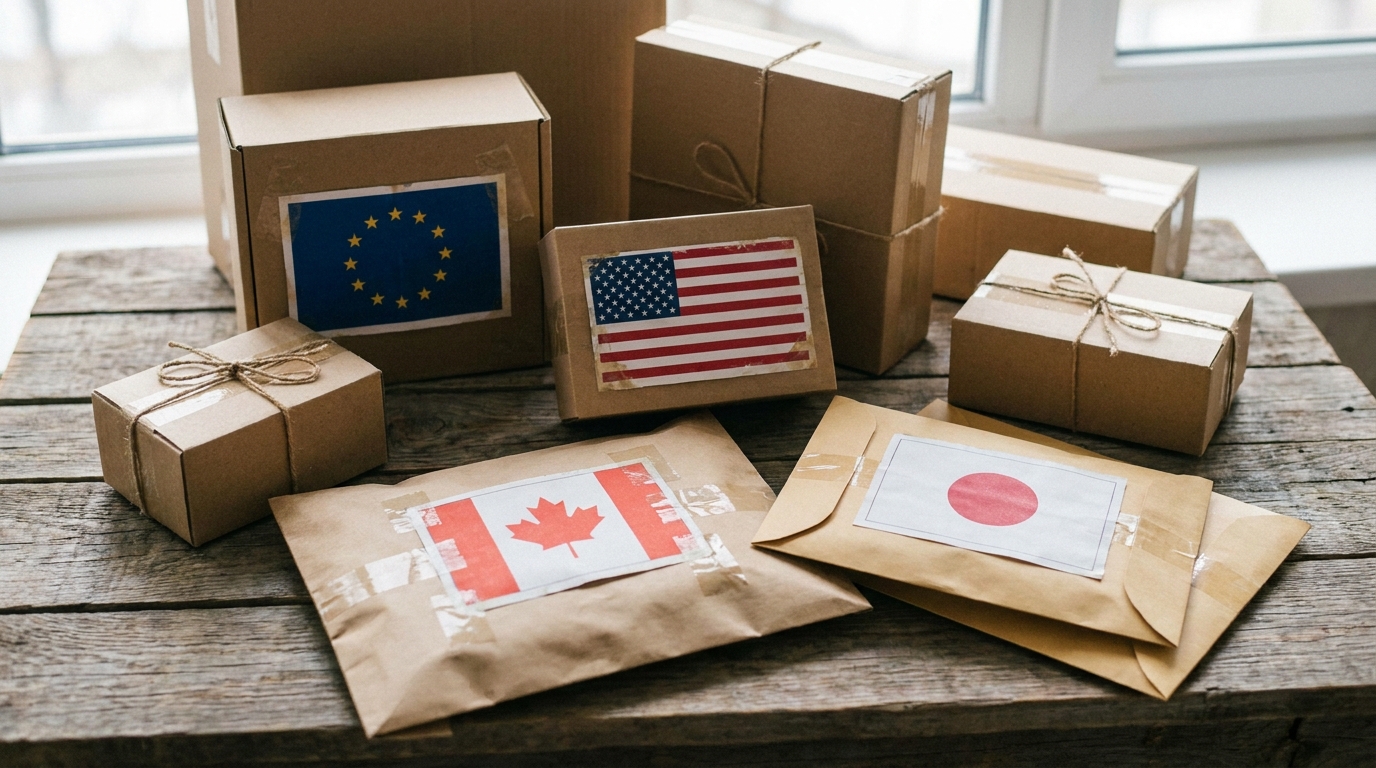
European Union import of a low-value order : You ship a 60 EUR fashion order from outside the EU to a buyer in France. Customs duty is waived (under 150 EUR), but VAT is collected from the first cent. The buyer therefore pays VAT even though the shipment is under the duty de minimis.
Australian import from a large foreign seller : A shopper in Australia orders electronics worth 200 AUD from a foreign store that exceeds the Australian GST registration threshold. The goods enter duty-free (under 1 000 AUD), yet the seller adds GST at checkout. No tax relief from de minimis applies.
Canadian import from a United States warehouse : A shopper in Canada buys a 120 CAD product from a U.S. seller. If the shipment meets trade-agreement conditions, Canada may waive duty up to 150 CAD and tax up to 40 CAD, allowing the parcel to enter tax- and duty-free. Otherwise, standard charges apply.
How to use de minimis thresholds in your import strategy
Key steps to use de minimis thresholds
- Identify your target import country and shipment type, then consult a trusted global comparison table for the latest duty and tax de minimis values.
- Distinguish between duty-free and tax-free. True relief requires both thresholds above your shipment value or a trade agreement that waives duty.
- Map your product mix against local exceptions such as alcohol, tobacco or sensitive electronics.
- Watch origin-based rules. Some countries grant higher thresholds for preferred trade partners.
- Update your assumptions regularly; de minimis regimes can change quickly.
AirSelli can support this planning by giving you a stable international delivery address and flexible parcel forwarding. With our how-it-works guide, you can see how to consolidate purchases, choose shipping options and anticipate customs interactions for each route. For more support, reach out via our contact page.
Limits and risks of relying on de minimis
De minimis thresholds offer real advantages for cross-border shopping and selling, but they also come with limits.
Authorities can change thresholds or suspend regimes in response to trade or political pressures, as seen with the historic 800 USD de minimis in the United States. Customs also retain discretion: misdeclared contents or incomplete invoices can trigger full assessment even below the threshold. Finally, de minimis relief often does not apply to returns, so reshipped replacements may face duties and taxes again.
We therefore encourage you to treat de minimis as an efficiency tool, not a guarantee. Sound documentation, honest value declarations and realistic communication with your customers matter just as much.
Mini FAQ about de minimis thresholds by country
Does de minimis always mean my shipment is completely tax-free ?
No. De minimis concerns thresholds for specific charges, not a promise of zero cost. In many countries a shipment under the duty de minimis still attracts VAT or GST.
Why do some sources list different de minimis values for the same country ?
Figures can differ because one source quotes the duty de minimis, another the tax de minimis, or different thresholds for postal versus express shipments.
How do the recent changes in the United States affect ecommerce sellers ?
The long-standing Section 321 allowance for shipments up to 800 USD has been effectively suspended by recent executive measures. Logistics experts now advise treating all U.S. imports as potentially dutiable and taxable.
Can I split a large order into several small parcels to stay under the de minimis threshold ?
Customs authorities are alert to this practice. If they conclude multiple parcels form one order, they can recombine the values and apply duty and tax.
How can AirSelli help with de minimis and international shopping ?
We provide international reception addresses and manage parcel forwarding via partner carriers. By consolidating parcels and optimising routes through our global shipping portal, we help you anticipate where customs attention and charges are more likely, even though we do not control customs decisions.
Understanding the de minimis threshold by country turns an opaque customs rule into a strategic advantage. Combined with reliable parcel reception and reshipment from AirSelli, you can design an international shipping approach that is transparent, compliant and far less prone to unexpected border costs.
Conclusion
By taking time to understand how the de minimis threshold by country interacts with duty, VAT or GST, you can forecast landed costs more accurately and avoid many surprise charges. When you combine up-to-date official guidance with a flexible parcel-forwarding partner such as AirSelli, it becomes much easier to plan cross-border purchases and deliveries that stay compliant while keeping overall customs friction under control.