

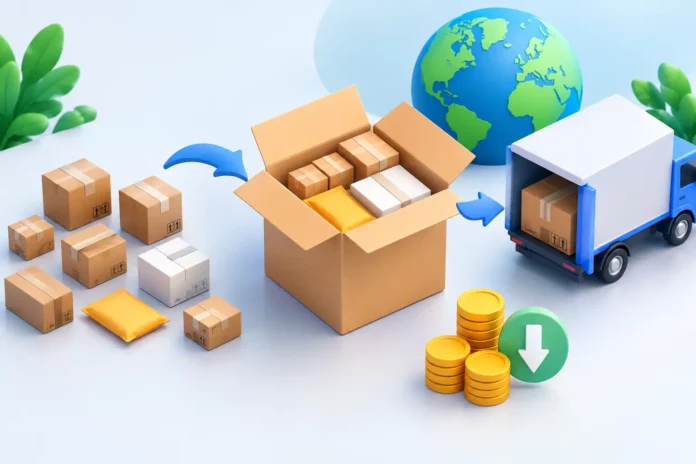

A great item price can disappear the moment five separate international shipping charges appear at checkout. Package consolidation gives you another option: send your purchases to one local address, hold them until you are ready, and forward them together in a single shipment.
For shoppers buying from France or China, this is often the difference between placing the orders you want and paying more than necessary to receive them. Instead of treating each retailer purchase as a separate international delivery, you can plan shipping around your budget, timing, and destination.
What Package Consolidation Means
Package consolidation is a forwarding service that combines multiple incoming parcels into one outbound international shipment. You shop with different retailers, use your assigned local delivery address at checkout, and your orders arrive at a forwarding warehouse. Once all or most of your items are there, they can be prepared for shipment together.
The goal is straightforward: reduce the duplicated costs built into separate deliveries. Each parcel may have its own outer box, packing material, handling requirements, and carrier charges. Combining purchases can reduce excess packaging and allow shipping to be calculated on one shipment rather than several.
This does not mean every order will cost less in every situation. Shipping rates depend on the destination, package dimensions, actual weight, volumetric weight, carrier rules, and the goods being shipped. But for several small or medium purchases, consolidation is frequently the most practical way to control cross-border delivery costs.
Why Separate Packages Cost More
International shipping has fixed costs that repeat with every parcel. A small beauty order, a pair of shoes, and a phone accessory may each be inexpensive to buy, but each shipment still needs to be received, labeled, processed, and transported across borders.
Dimensions matter as much as weight. Carriers may charge based on volumetric weight when a box takes up more space than its actual weight suggests. Sending multiple retail boxes separately can mean paying for empty space multiple times. Repacking several items into a more suitable carton can reduce that waste.
Consolidation also gives you fewer shipments to track, fewer international delivery events to coordinate, and less chance of paying separate clearance-related charges across multiple deliveries. It cannot eliminate customs duties, taxes, or import restrictions, but it can make the shipping side more organized.
How the Process Works
The process starts with a local address. After creating an account, you receive a delivery address in France or China that you can use when a retailer only ships domestically. Enter that address during checkout, including any account or suite details exactly as provided.
When your retailer sends the order, it arrives at the warehouse instead of being dispatched internationally right away. This creates the waiting period that makes consolidation possible. You can receive purchases from several stores, review what has arrived, and decide when to send them onward.
With Airselli, shoppers can use a free address in France or China and receive up to 90 days of free storage. That window is useful when retailers ship orders on different schedules, when you are waiting for a sale purchase to arrive, or when you want to build one shipment from several orders.
After your items are ready, submit your forwarding request and choose the available shipping option that fits your budget and delivery needs. The warehouse prepares the parcel for international dispatch, and the completed shipment is sent to your destination. Airselli ships to more than 150 countries, so the same approach can work whether you are ordering from the United States or another supported market.
When Consolidation Is Most Worthwhile
Consolidation works best when you have multiple purchases headed to the same person and destination. It is especially useful for shoppers who buy from several French boutiques, Chinese marketplaces, or specialty retailers that do not offer international shipping.
Consider using it when you are ordering fashion from different stores, collecting beauty products during promotional periods, buying home goods that arrive in separate parcels, or combining accessories with a larger purchase. It is also useful when you want to compare purchases before paying for international forwarding.
There are situations where it may not be the best choice. If one item is urgent, waiting for other orders could delay delivery. If an item is large, fragile, restricted, or unusually heavy, it may need separate handling. A single low-cost item can also be less economical to hold if the savings from combining it are small compared with the urgency of receiving it.
The practical question is not simply, “Can these packages be combined?” It is, “Will combining them lower my total cost and fit my delivery timeline?”
Plan Your Orders Before You Buy
A little planning helps you get more from package consolidation. Start by deciding what you want to ship together. If you are shopping a seasonal sale, for example, place orders within a similar time frame so they are more likely to reach the warehouse before your storage period ends.
Check retailer processing times before you order. Some stores dispatch within a day or two, while others may take a week or longer. Preorders, customized items, and marketplace purchases can take even more time. Knowing those estimates helps you avoid forwarding a nearly complete shipment just before the final item arrives.
It also helps to keep records of every order. Save order confirmations, tracking numbers, item descriptions, and values. This information makes it easier to identify incoming parcels and prepare accurate customs declarations. Accurate descriptions and values are essential: they support customs processing and reduce avoidable delays.
What to Check Before Combining Packages
Before you request consolidation, look at the contents as a complete shipment rather than as individual orders. Ask whether the total value may affect duties or taxes in your destination country. Customs rules vary, and the recipient is responsible for complying with local import requirements.
Review whether any item has shipping limitations. Products containing lithium batteries, liquids, aerosols, fragrances, magnets, food items, or branded goods may be subject to carrier or destination restrictions. A restricted item can affect the shipping options available for the entire parcel.
Think about protection, not just price. Removing unnecessary outer packaging can reduce size, but fragile items may need careful cushioning. The lowest shipping cost is not a good result if an item arrives damaged. The right preparation balances compact packing with the level of protection your goods require.
Finally, compare shipping choices based on total value, urgency, and tracking needs. A less expensive service may be suitable for low-value, non-urgent purchases, while a faster or more fully tracked option may make sense for important orders. The best option depends on what you are sending and how soon you need it.
Common Mistakes That Reduce Savings
The most common mistake is forwarding too soon. Sending the first two packages because they have arrived can remove the cost advantage of waiting for the next three. Use your storage period deliberately, especially when you know other orders are already in transit.
Another mistake is overlooking parcel size. A lightweight item in a very large retail box can raise volumetric weight. Consolidation and repacking may help, but shoppers should still account for items that are naturally bulky, such as footwear, luggage, or home décor.
Shoppers also lose time when they enter an incomplete warehouse address or do not include the required account identifier. Retailers need the full address details so the warehouse can match each arrival to the correct customer account. Review the address before placing every order, particularly when buying from a new retailer.
Make International Shopping Work on Your Terms
Buying from France and China should not force you to accept separate international shipping charges for every store. With a local delivery address, time to gather your orders, and one planned outbound shipment, you can turn scattered purchases into a clearer delivery plan.
Use package consolidation when it serves the purchase, not as a rule for every order. Wait when savings are meaningful, ship sooner when timing matters, and prepare each shipment with accurate details. That balance gives you more control over what you buy, when it ships, and what you pay to bring it home.